

Remember when building a recording rig meant wrestling with massive mixing consoles and miles of bulky analog cable? Today, pristine digital sound lives right inside your desktop chassis, provided your internal wiring can actually keep up with the demands of high fidelity audio.
Sorting through internal connectors might not feel as glamorous as buying a new studio microphone, but these small links dictate your final signal clarity. And catching a grounding hum or a loose connection too late in the mixing process can ruin an entire session.
Let us walk through four essential internal audio accessories that help you piece together the best motherboards for audio production setup. Keep reading to see which specific cabling solutions solve common studio routing headaches.
Key Takeaways
- Prioritize cable shielding to prevent electromagnetic interference from neighboring power supplies and graphics cards inside your computer case.
- Match your header types carefully by checking if your specific chassis or audio interface requires AC97 or HD Audio pin configurations.
- Measure the exact physical distance between your motherboard headers and front panel ports before purchasing extension leads.
- Look for gold plated connectors to ensure corrosion resistance and optimal signal transfer over years of studio use.
- Verify whether your projects demand optical S/PDIF outputs for pristine digital signal transmission to external gear.
| Extended Reach Essential |  |
LUORNG Front Audio Extension Cable | Generous 30cm length | Secure male to female connection | Clean chassis cabling | View on Amazon | Read Review |
| Dual Output Adapter | 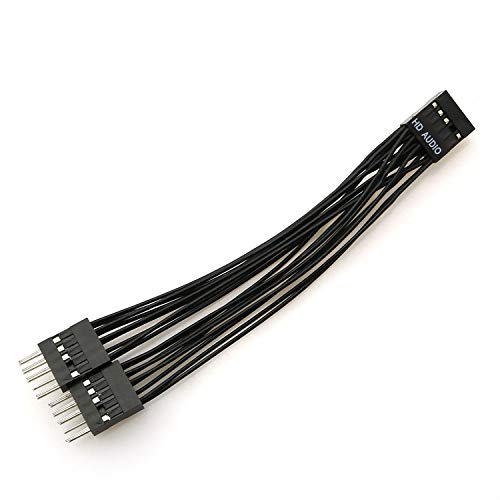 |
ZRM&E HD Audio Splitter Cable | Convenient splitter design | Compact 10cm wire | Maintains HD audio clarity | View on Amazon | Read Review |
| Digital Audio Expansion |  |
SPDIF Optical and RCA Out Plate | Adds optical output | Includes RCA connection | Fits standard chassis slots | View on Amazon | Read Review |
| Dual Pack Connector |  |
ZORZA Front Panel Audio Extension | Includes two cables | Supports HD and AC97 | Durable 24AWG wiring | View on Amazon | Read Review |
More Details on Our Top Picks
-
LUORNG Front Audio Extension Cable
Setting up a studio desk requires routing cables just right, and this 30cm extension cable helps you connect your front panel audio without stretching your wiring to its absolute limit. You get a reliable 9-pin HD audio connection that bridges the gap between your chassis and your motherboard ports cleanly.
And because studio environments demand tidy signal paths, keeping your internal wires organized prevents annoying electronic interference. But you should remember that this is simply an extension tool rather than a standalone audio processor, meaning your onboard motherboard audio quality remains the primary factor for your sound.
- Brand:LUORNG
- Type:Front audio extension cable
- Length:30cm
- Connector Type:9-pin HD Audio male to female
- Compatibility:Standard computer chassis
- Quantity:1 piece
- Additional Feature:Protective connection sleeve
- Additional Feature:Standard 9 pin layout
- Additional Feature:Flexible chassis wiring
-
ZRM&E HD Audio Splitter Cable
Routing one motherboard audio header to multiple destinations can feel like a puzzle, but this 1 female to 2 male splitter simplifies complex studio rig configurations. It handles high-definition audio signals accurately, allowing you to split your front panel connections without losing signal integrity along the way.
The 10cm length keeps your internal case wiring compact and free from messy tangles that ruin airflow. Yet, you will want to plan your routing carefully since the shorter wire run leaves very little room for error inside larger computer towers.
- Brand:ZRM&E
- Type:Audio splitter cable
- Length:10cm
- Connector Type:1 female to 2 male
- Compatibility:Standard motherboard audio headers
- Quantity:1 piece
- Additional Feature:9-pin configuration
- Additional Feature:High-definition signal routing
- Additional Feature:Flexible lead wire
-
SPDIF Optical and RCA Out Plate
Connecting professional studio monitors and external converters requires reliable digital outputs, and this expansion bracket adds SPDIF optical and RCA ports directly to your system. It mounts cleanly onto your computer chassis, giving you pristine digital connectivity without forcing you to upgrade your entire motherboard for a single port.
Compatibility spans across major hardware manufacturers, making this a smart addition to your custom audio workstation. But do check your motherboard manual first to ensure you have an available internal SPDIF header ready for this bracket.
- Brand:Generic
- Type:Out plate cable bracket
- Connector Type:SPDIF optical and RCA
- Compatibility:ASUS, Gigabyte, and MSI motherboards
- Quantity:1 bracket with cable
- Additional Feature:Rear panel mounting plate
- Additional Feature:Digital audio transmission
- Additional Feature:Secure internal header connection
-
ZORZA Front Panel Audio Extension
Building multiple rigs or keeping spare parts on hand makes this two-pack extension set a practical choice for any audio workstation project. Each cable spans 20cm in length, utilizing 24AWG wiring to deliver dependable power and signal transmission from your motherboard to your front panel.
Support for both HD and AC97 standards ensures you will not run into sudden compatibility roadblocks when swapping older chassis parts. Just keep in mind that the 20cm measurement might require careful routing if your motherboard audio header sits far away from your case front panel connectors.
- Brand:ZORZA
- Type:Front panel audio extension
- Length:20cm
- Connector Type:9 pin male to female
- Compatibility:HD and AC97 audio standards
- Quantity:2 pieces
- Additional Feature:Standard motherboard connector
- Additional Feature:Flexible chassis cabling
- Additional Feature:Dual-compatibility design
Frequently Asked Questions
Do I need a dedicated sound card if I buy a high-end motherboard?
Almost certainly not, because modern motherboards feature premium built-in codecs that handle basic monitoring just fine. Most serious producers connect an external USB audio interface anyway, which completely bypasses the internal sound card.
What causes audio clicks and pops during playback?
Those annoying artifacts usually stem from high DPC latency caused by poorly written network or graphics drivers. Updating your chipset drivers and disabling unused components like integrated Wi-Fi usually solves the problem.
How much RAM do I actually need for music production?
You can get by with 16GB for basic multitrack recording, but 32GB is the sweet spot for modern electronic music production. If you plan to load massive orchestral sample libraries, jump straight to 64GB or more.
Are gaming motherboards good for making music?
Yes, because gaming boards feature fast processors, robust power delivery, and plenty of high-speed I/O ports. Just make sure to check user reports regarding audio driver stability before purchasing.
Should I prioritize Wi-Fi or wired Ethernet on my studio PC?
Always use a wired Ethernet connection for your studio computer if possible to avoid network interference and latency spikes. Wi-Fi modules can sometimes introduce electrical noise that creeps into sensitive audio circuits.