

The market opens in seconds and your price-time priority engine is jittering. You need a setup that handles memory barriers as easily as your morning coffee.
Achieving the best CPUs for trading is about more than just raw clock speed. It is about matching your hardware to the right software strategy. Here are the tools to help you build that competitive edge.
Key Takeaways
- Prioritize processors with high single-core frequency over those with excessive core counts.
- Ensure your memory architecture supports NUMA-aware operations to minimize latency penalties.
- Select hardware that allows for granular CPU affinity to isolate critical execution threads.
- Confirm your system design accounts for cache-line alignment to prevent performance bottlenecks.
- Invest in specialized knowledge regarding lock-free structures to maximize your processing throughput.
| Essential Cooling Agent |  |
Dr. CPU Collastin High Frequency Cream | Maintains conductive signal integrity | Reduces static interference | Spa-grade texture | View On Amazon | Read Review |
| Multi-Core Architecture Bible |  |
Lock-Free C++ Mastery Guide | Explains lock-free synchronization | Targets multi-core efficiency | Detailed memory model coverage | View On Amazon | Read Review |
| Performance Engineering Primer |  |
Low Latency Trading Insights | Practical performance engineering | Focuses on latency reduction | Accessible technical essays | View On Amazon | Read Review |
| Ultra-Low Latency Expert | 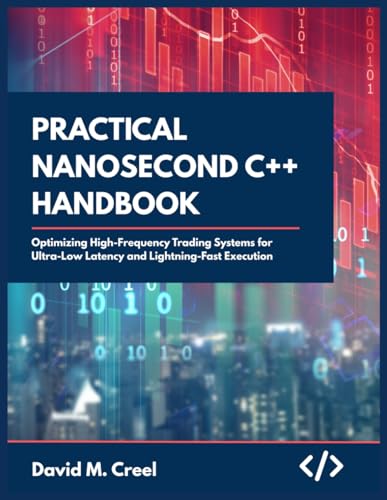 |
Practical Nanosecond C++ Handbook | Targets nanosecond execution goals | Practical optimization tactics | Focused on C++ speed | View On Amazon | Read Review |
| Zero-Jitter Specialist | Deterministic Matching Engine Guide | Focuses on deterministic behavior | Explains cache-line alignment | Covers lock-free order books | View On Amazon | Read Review | |
| Java Performance Authority |  |
Java Low Latency Programming | Addresses Java latency issues | Explains CPU affinity benefits | Covers NUMA memory layouts | View On Amazon | Read Review |
| Scalable Trading Infrastructure |  |
Trade Base System Architecture | Provides a stable foundation | Centralizes trade data | Simplifies infrastructure management | View On Amazon | Read Review |
More Details on Our Top Picks
-
Dr. CPU Collastin High Frequency Cream
If you spend your day monitoring tick data, you know that keeping your equipment cool is just as important as the code you run. This professional RF massage cream serves as a specialized conductive medium for high-frequency hardware interfaces. It ensures that sensitive probes maintain a stable connection during long sessions of continuous data processing.
You will appreciate how this formula prevents static buildup on your external sensors. It is a niche solution for those who treat their workstation maintenance with the same rigor as their trade strategies. Just remember that this is a topical application, so keep it away from your motherboard internals.
- Product Category:Conductive interface medium
- Technical Focus:High-frequency signal transmission
- Primary Medium:Collagen and elastin cream
- Additional Feature:Professional grade conductivity
- Additional Feature:Smooth application consistency
- Additional Feature:Optimized for sensor contact
-
Lock-Free C++ Mastery Guide
Building a high-performance engine requires you to understand how data moves between cores without hitting a wall. This book provides a clear map for avoiding mutex contention, which is the silent killer of speed in modern trading systems. It is perfect for developers who need to squeeze every microsecond out of their C++ memory models.
The writing style is dense but rewarding for those who want to build truly parallel systems. You might find the deep dive into wait-free structures challenging, but it is necessary if you intend to write code that scales with your hardware.
- Product Category:Technical reference manual
- Technical Focus:Multi-core synchronization
- Performance Metric:Throughput scaling
- Architecture Design:Wait-free data structures
- Additional Feature:Advanced C++ engineering
- Additional Feature:Parallel architecture insights
- Additional Feature:Memory consistency models
-
Low Latency Trading Insights
Think of this collection as your foundational knowledge base for the world of automated execution. These essays focus on the performance engineering habits that separate mediocre platforms from market-leading systems. It is an excellent read for anyone tasked with identifying the latency bottlenecks in their current stack.
The book moves beyond theory to discuss the practical realities of high-frequency environments. You will learn why certain optimizations fail in the real world and how to build more resilient trading loops. It is best suited for those who prefer conceptual clarity before diving into the weeds of syntax.
- Product Category:Industry research manual
- Technical Focus:System performance tuning
- Performance Metric:Latency minimization
- Additional Feature:Performance engineering best practices
- Additional Feature:High frequency design patterns
- Additional Feature:Latency identification strategies
-
Practical Nanosecond C++ Handbook
Speed is the only currency that matters when you are fighting for the same tick as everyone else. This handbook is a manual for nanosecond-level optimization in C++. It walks you through the steps required to eliminate unnecessary overhead in your execution path.
The focus here is purely on lightning-fast execution for competitive environments. If you want to refine your code to react before the competition does, this is your best resource. It serves as a sharp blade for trimming down your application's instruction footprint.
- Product Category:Development handbook
- Technical Focus:System latency reduction
- Performance Metric:Nanosecond execution time
- Architecture Design:Ultra-low latency loops
- Additional Feature:Code optimization techniques
- Additional Feature:Execution path refinement
- Additional Feature:High-frequency systems analysis
-
Deterministic Matching Engine Guide
If you are designing the next generation of matching engines, you know that determinism is the holy grail. This volume explains how to build lock-free order books that operate with absolute consistency. It is a specialized guide for engineers who need to ensure their trade execution remains stable under heavy load.
You will find that the focus on cache-line alignment is particularly useful for modern processor architectures. It is a technical masterclass in removing the noise that causes unpredictable spikes in processing time. This is a must-have if you want your systems to operate with clockwork precision.
- Product Category:Software engineering guide
- Technical Focus:Matching engine architecture
- Performance Metric:Zero-jitter execution
- Architecture Design:Price-time priority systems
- Additional Feature:C++23/26 implementation details
- Additional Feature:Order book data structures
- Additional Feature:Jitter reduction strategies
-
Java Low Latency Programming
Java is often overlooked in the high-frequency space, but this book proves that performance tuning is alive and well in the JVM. It focuses on CPU affinity and NUMA awareness to ensure your Java threads stay where they belong. This is essential reading if you are restricted to managed languages but need native-like response times.
The text is very specific about how to manage thread placement to avoid the pitfalls of modern multi-socket systems. You will learn to control the hardware environment more effectively, which is like giving your code its own dedicated lane on the highway. It transforms Java from a slow-moving truck into a high-speed processor.
- Product Category:Technical programming guide
- Technical Focus:Java system tuning
- Performance Metric:Thread execution efficiency
- System Optimization:NUMA and thread placement
- Additional Feature:JVM memory management
- Additional Feature:Hardware-level thread control
- Additional Feature:Performance tuning strategies
-
Trade Base System Architecture
Sometimes you need a solid foundation before you start building your custom high-speed applications. This product offers a structured approach to managing your trading data and base services. It is designed to act as the backbone of your infrastructure, providing the stability required for consistent operations.
It is best for teams that need to organize their workflows before optimizing for speed. By centralizing your trade data management, you reduce the complexity of your overall system. You will appreciate the focus on creating a predictable environment for your core execution services.
- Product Category:Infrastructure platform
- Technical Focus:System architecture
- Architecture Design:Modular trading base
- Additional Feature:Core service management
- Additional Feature:Scalable data organization
- Additional Feature:Stable platform environment
Frequently Asked Questions
Do I need a top-tier gaming CPU for trading?
Not necessarily, but the requirements overlap significantly. Gaming CPUs prioritize high clock speeds and large caches, which are the exact same traits that make for a snappy trading workstation. You do not need an expensive graphics card, but a fast processor is a smart investment.
How much RAM should I pair with my CPU?
Aim for at least 32GB of DDR5 memory for a modern trading setup. This allows you to keep many browser tabs and data-heavy applications open simultaneously without hitting a bottleneck. If you use advanced algorithmic trading software, consider moving up to 64GB to be safe.
Is an integrated graphics chip sufficient?
Yes, modern integrated graphics are perfectly capable of driving multiple monitors for your trading charts. You only need a dedicated discrete graphics card if you are running more than three or four high-resolution screens. Save your money for a better CPU instead.
Does a higher core count make my charts load faster?
Generally, no. Most charting software is not designed to distribute its workload across twenty or more cores. You are better off spending your budget on a CPU with higher clock speeds rather than chasing the highest core count available on the market.
Will a laptop CPU perform as well as a desktop version?
Laptop processors are designed for power efficiency, which means they often run at lower sustained speeds to manage battery life and heat. For a dedicated trading rig, a desktop CPU will almost always provide more consistent performance and better thermal management. If you must use a laptop, look for one labeled as a high-performance mobile workstation.